In the drawing rooms of Western commentary, India’s place in the world is often discussed as though a chair awaits delivery. The West must recognise its importance, accommodate its strategic autonomy and avoid demands that might alienate an indispensable partner. India’s arrival at the high table appears inevitable; only the seating arrangements remain unsettled.
The argument has substance. India’s market, geography, technical talent and military weight give it considerable bargaining power. Cooperation through the Quad, semiconductor investment and defence production reflects interests that no serious government can dismiss. Nor are Indian objections to Western double standards imaginary. Countries that invoke sovereignty selectively have little standing to lecture others on consistency.
But indispensability is a negotiating asset, not insurance against coercion. A country may be courted for what it offers and pressured for what it cannot afford to lose. The invitation and the squeeze can arrive together.
This is where the flattering account of India’s ascent becomes misleading. It confuses being useful to powerful states with acquiring power over the terms of that usefulness.
Indian strategists need not look abroad to understand the distinction. Their own corporate economy supplies an instructive example.
Consider the transfer of Mumbai airport from GVK to Adani. GVK possessed a strategic asset, operating experience and relationships with substantial investors. Yet debt, financing difficulties and investigations converged around its airport business before Adani secured control. GVK’s vice-chairman subsequently denied that pressure had forced the sale. That denial belongs in the account; so does the sequence that made the transaction politically contentious.
The analogy rests on a question larger than any disputed account of the deal: what is ownership worth when someone else can command the financing, access or permissions needed to sustain it?
A balance sheet can display formidable assets while concealing dependence. An incumbent can look secure until the conditions of its security change.
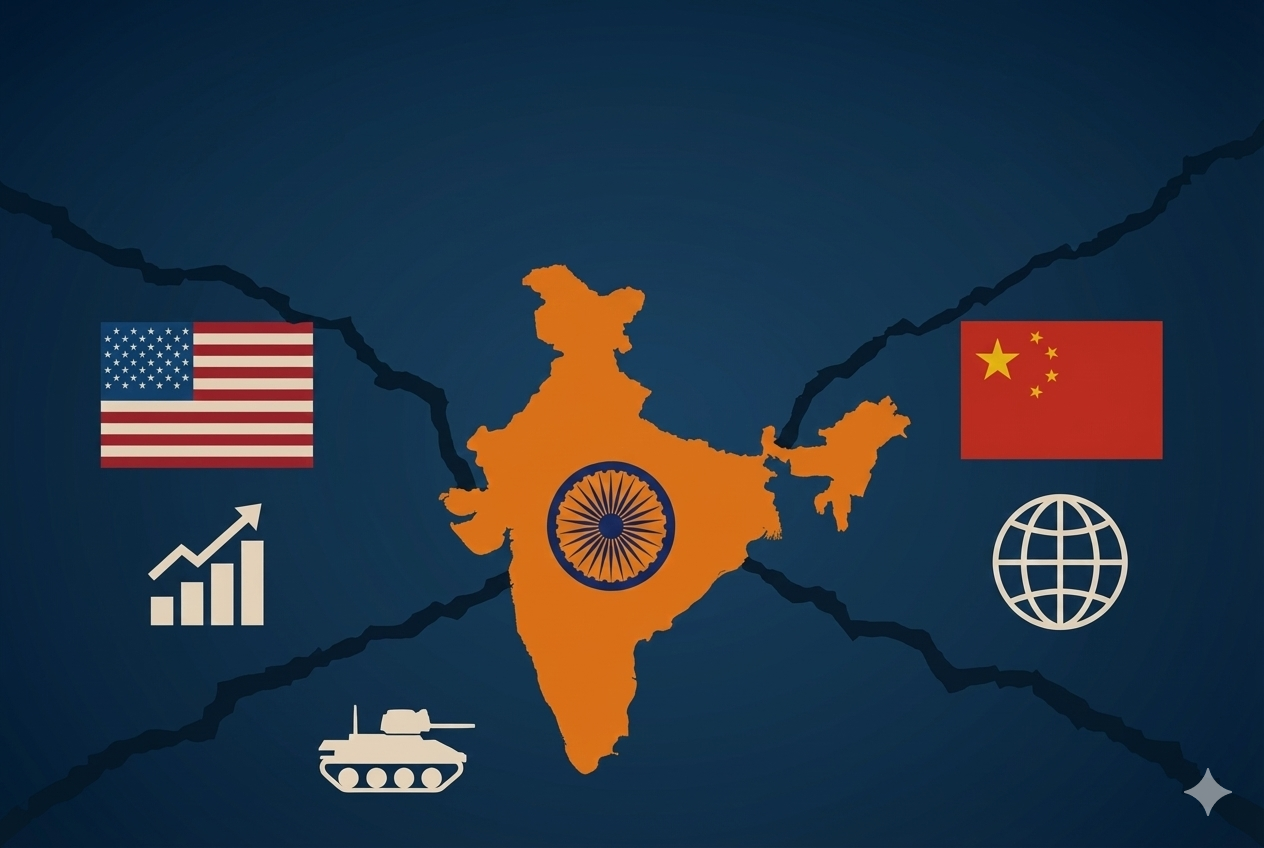
Sovereign states face the same problem on a larger and more dangerous scale. Washington can exert pressure through access to its market, technology, finance and security relationships. Its leverage need not be unlimited to be effective. It needs to reach something the other side cannot readily replace.
India has resources with which to bargain. The question is how long it can withstand the interruption of what it needs—and how long its counterpart can withstand losing what India supplies. Strategic autonomy becomes real at that point of unequal endurance.
None of this makes international relations a deterministic equation. Governments miscalculate; coalitions shift; domestic resistance changes what leaders can concede. Credibility, public opinion and institutional trust can affect outcomes alongside economic and military strength.
Indeed, powerful governments routinely demand changes in behaviour when others seek their cooperation. They attach conditions while rejecting comparable scrutiny of themselves. Their hypocrisy does not make those conditions disappear. It makes dependence more costly.
India therefore faces two connected tasks: building the capacity to resist coercion and establishing the credibility to organise support against it. Domestic governance bears directly on both.
An independent regulator makes investment less dependent on political access. A credible court reduces the risks of building an enterprise outside a favoured network. Open competition widens the country’s productive base. Universities that permit disagreement cultivate the intellectual independence on which technological autonomy depends.
These institutions give a country more options when a powerful partner begins attaching conditions. Their erosion leaves national ambition resting on fewer firms, fewer decisions and fewer people.
Yet New Delhi’s public presentation of power often places extraordinary weight on personal diplomacy. The Prime Minister’s embraces offer its most recognisable image: intimacy with the leader standing beside him, broadcast as evidence of India’s standing.
A hug may express warmth. It cannot establish what the photograph invites citizens to infer. Access to a leader says little about the terms that survive the meeting. The test comes when interests diverge: what can India refuse, what can it secure, and what will the relationship withstand?
Personal diplomacy earns its place when institutions convert access into durable advantage. Without that conversion, the embrace becomes an advertisement whose claims the negotiation has yet to honour.
The gap between presentation and practice extends to India’s demand for a fairer international order. Delhi rightly objects when powerful countries bend rules, punish dissenters or reserve privileges for themselves. Its argument loses authority when similar questions arise at home.
Disputes over electoral rolls, allegations of selective enforcement against opposition figures, preventive detention and restrictions on protest concern the substance of democratic standing. Internet shutdowns also carry documented costs for livelihoods and access to essential services. Sovereignty cannot answer these questions; it establishes who is responsible for answering them.
India need not achieve perfection before criticising anyone else. Its citizens’ rights are not an examination administered by Washington. But a government asking other countries to trust its vision of shared power must expect scrutiny of how it handles power already entrusted to it.
The same scrutiny applies to trade. India has legitimate reasons to protect vulnerable livelihoods and develop industrial capacity. Those purposes deserve an argument of their own. They cannot automatically justify every barrier while foreign restrictions are condemned as violations of fair exchange.
A defensible policy explains whom protection serves, what capability it builds and when its beneficiaries must compete. Otherwise, strategic autonomy risks becoming a grand name for arrangements that protect the well-connected from competition.
India’s claim to influence is substantial. Its achievement will depend on whether its people and institutions can turn national scale into widely distributed capability. A country whose businesses can challenge incumbents, whose citizens can challenge officials and whose institutions can withstand political displeasure has more strength available to it than one organised around privileged access.
That strength will not end American coercion, Chinese pressure or Western double standards. It will enlarge India’s freedom to respond—and make its appeal for a different order more persuasive to countries seeking freedom of their own.
India cannot choose whether stronger powers will test its dependencies. It can choose whether its domestic arrangements multiply them.
The embrace ends when the cameras leave. What remains is what India can build, what it can withstand and whether others can trust the rules it asks them to share.