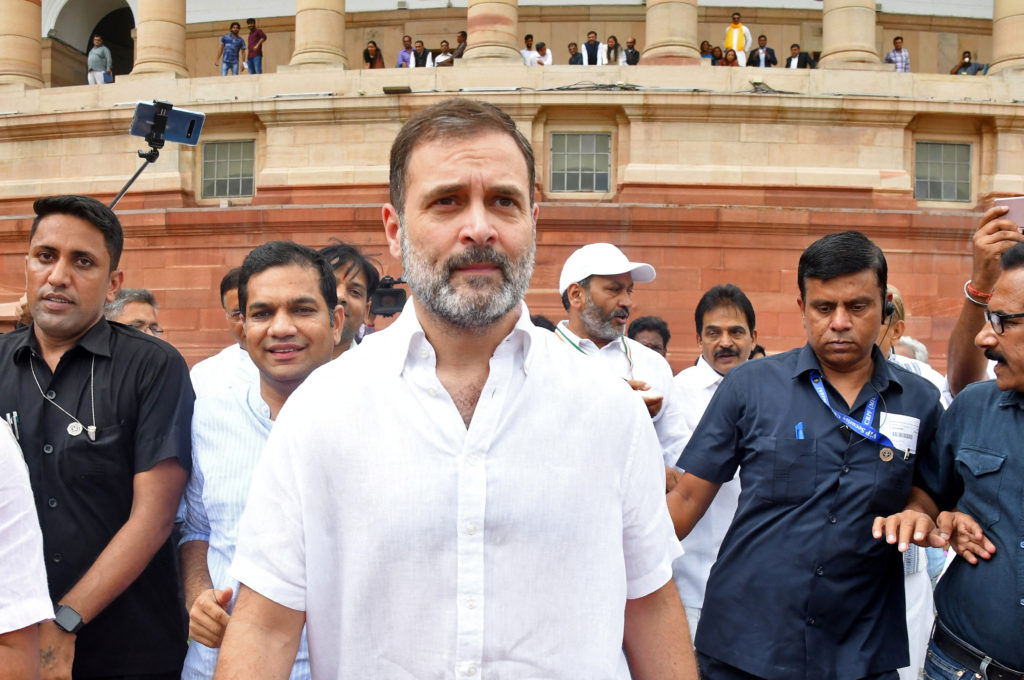
The central paradox of Rahul Gandhi’s political life is that he has become far more significant as an opposition leader than he ever appeared likely to become as a prime minister.
As an heir-apparent during the United Progressive Alliance years, his trajectory seemed constrained by an old consensus—a manager-in-waiting for a ruling machine that relied on central patronage and administrative quiet. Today, under conditions of majoritarian dominance, his distance from executive power has transformed from a liability into a source of freedom.
By abandoning conventional office-seeking, Gandhi has discovered a role that modern Indian politics rarely accommodates: the political dissident who uses his position to challenge the structural terms of the regime itself.
This transformation is rooted in a politics of refusal.
Refusal is not an escape into moral posturing; it is resistance to political closure. Dominant political orders maintain power not simply by winning elections, but by narrowing the horizon of the permissible—defining which questions can be asked, which statistics are legitimate, and whose injuries deserve national recognition.
In such an environment, refusal becomes a primary democratic act. It is the insistence that alternative possibilities remain visible even when state authority and media ecosystems would prefer to settle the debate.
Gandhi’s willingness to occupy the periphery—refusing UPA-era cabinet posts and resigning as party president after 2019—was long read by critics as a reluctance to accept direct administrative responsibility.
Yet that very distance allowed him to articulate a counter-narrative that an office-seeker could not afford to voice.
Taking politics back to the road in the Bharat Jodo Yatra, he bypassed a tightly managed media environment and his party’s compromise-prone middle tier. In doing so, he brought economic inequality, youth unemployment, and constitutional rights into a single national argument.
The power of this stance lies in its ability to alter the national conversation without holding office. The campaign for a caste census illustrates the reach of this approach. On April 30, 2025, when the Union Cabinet formally approved caste enumeration for the decennial census, Gandhi’s national campaign—alongside Bihar’s state survey and pressure from regional allies—had helped bring the question to the centre of national debate.
By centering his interventions on structural inequities, he drew a dominant executive onto the opposition’s core ideological terrain.
Yet the qualities that make Gandhi a vital opposition leader reveal the costs of his approach. A politics defined by refusal is effective at diagnosing structural injuries and forcing narrative pivots, but it risks remaining permanently oppositional—ill-equipped to assemble the disciplined, transactional machinery required to govern.
This limitation sits at the heart of his strategy. Gandhi’s implicit wager appears to be that public visibility can generate party organization—that if a moral argument is sustained with sufficient stamina, the electoral machinery will naturally coalesce around it.
Political history suggests that more often, durable organization precedes and sustains public visibility. In post-colonial India, figures like Jayaprakash Narayan demonstrated how a mass movement outside formal office could reshape public consciousness, yet that movement ultimately depended on existing party cadres—from the socialists to the Jana Sangh—to construct a viable electoral alternative.
A political party cannot walk past its intermediaries. It needs local workers who can organize when the cameras have gone, resolve disputes, and bring voters to the booth.
While the 2024 general election saw the Congress rise from 52 to 99 Lok Sabha seats—increasing its vote share from roughly 19.5 per cent in 2019 to 21.19 per cent—subsequent state contests exposed the gap between a national campaign and local booth machinery. Defeat in Bihar and the ruling party’s expansion in West Bengal showed that moral presence on the road does not automatically yield a functioning organization on the ground, even as success in Kerala offered a different lesson.
The same tension strains his alliances within the INDIA front, where regional partners demand tactical flexibility rather than a single ideological language dictated from Delhi.
When the state moved against him in 2023—disqualifying him from Parliament after a criminal defamation conviction, until the Supreme Court stayed it—it inadvertently underscored his status as the regime’s principal counter-weight.
Reinstated and subsequently elevated to Leader of the Opposition in the Lok Sabha, Gandhi gained a constitutional platform to demand executive accountability in parliamentary committees and statutory appointments, bringing a measure of scrutiny that numbers alone could not provide.
The ultimate test posed by Gandhi’s trajectory is not whether he himself eventually reaches executive power, but what his path reveals about the health of democratic institutions as a whole.
His career has demonstrated that an opposition leader can be vital without being immediately victorious, and that keeping the democratic horizon open is an achievement distinct from capturing the state. Whether he can turn that stubborn opposition into a durable structural alternative remains the unfinished work of his politics—but he has already shown that the true measure of an opposition is not how smoothly it fits the machinery of power, but how forcefully it refuses to let that machinery define the nation.