At Sonia Gandhi’s memoir launch, her son recalled a family habit that helped him explain what political violence had taken from them. By the next day, the argument was about a temple.
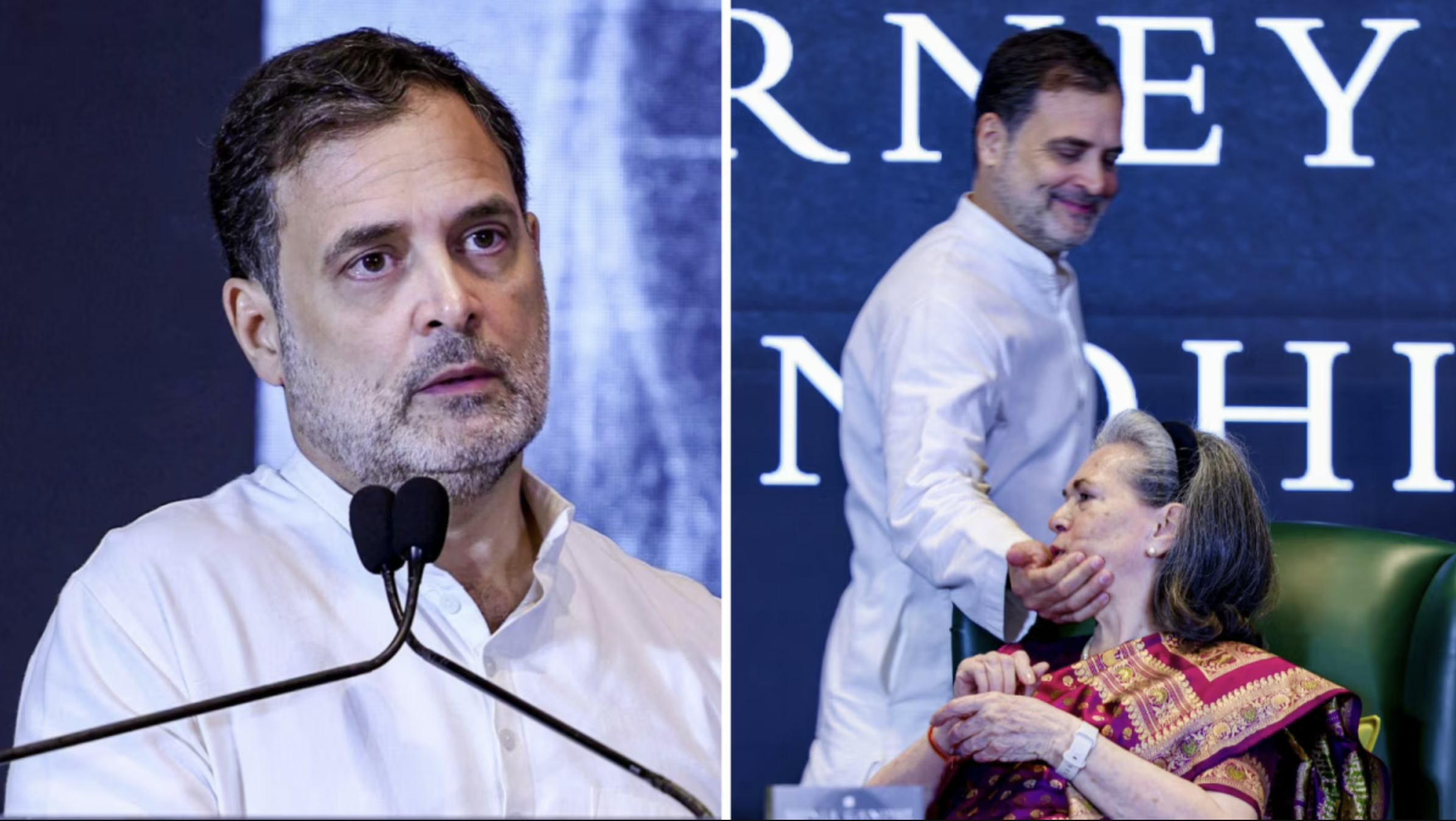
At the launch of Sonia Gandhi’s Belonging: A Journey of Love in New Delhi on November 16, Rahul Gandhi recalled that his mother used to sit on his father’s lap at meals. When he visited friends as a boy, he wondered why their parents sat apart. The joke was at the child’s expense. He had taken his own household for a rule of the world. And he wanted the audience to picture that household while it was still whole.
He spoke first of Indira Gandhi’s assassination, after which his mother began to draw inward, and then of Rajiv’s. After his father’s death, he said, the smiling, outgoing woman he had known disappeared. Sonia had described those years from inside them earlier that evening. Rahul and Priyanka had looked after her, she said, until it felt as though they had become the parents and she the child. An assassination has a date and a place in public memory. The two speakers gave it an aftermath at home.
Himanta Biswa Sarma, the BJP chief minister of Assam, shared a video of the remarks and told Sonia that her son had embarrassed her at her own book launch. There is a fair question about discretion here. A son can tell a story about his childhood and still disclose something his mother would have preferred to keep private. Sarma treated that preference as settled. Sonia had just spoken in public about depending on her children in her grief. At an event devoted to what she had chosen to tell, a politician had taken it upon himself to tell her what she ought to feel.
Rahul made his own claim about other people’s feelings the next day. He posted an image from the Hoysaleshwara temple at Halebidu, in Karnataka, showing Shiva and Parvati riding Nandi, and said fear, anger and hatred kept BJP and RSS supporters from experiencing and expressing love. He invoked his duty as a “true Hindu” and signed off with “Satyam Shivam Sundaram.” The carving made a case for tenderness without a word. The words that accompanied it were less generous. At the launch, Rahul had shown how easily the public could mistake a woman’s reserve for her nature. In his reply, a political affiliation was enough to tell him what a stranger felt.
Sarma objected to the comparison with the deities. The BJP took the argument elsewhere. It asked who had ransacked the old Hoysala capital, named Malik Kafur and the army of Muhammad bin Tughlaq, and pointed to damaged idols. “Satyam comes first,” the party replied. The two posts sent the eye to different places. Rahul asked it to rest on Shiva and Parvati together. The BJP directed it to the broken faces and hands elsewhere at the site. By then, the recollection of a marriage had become an argument over who could speak for a religious tradition.
At the launch, there had been another difference in emphasis, between Rahul’s account and Sonia’s own. He spoke of people in Indian villages giving her a new sense of belonging after Rajiv’s death. She dated her first feeling of belonging to a visit to his constituency, Amethi. People there could chide her for what she did not know, she recalled, without making her foreign accent or the way she tied her sari a test of whether she belonged. She spoke of how hard a woman can work to be accepted in a new household, and of how keenly she had felt watched. In Amethi, people could correct her and count her as one of their own at the same time. The marriage had brought her there. What happened when she arrived was between her and the people she met.
A party knows how to commemorate an assassinated leader. It can tell the country what it lost. At the launch, Rahul could tell us who his mother had been while that leader was alive. Sonia could tell us how much living there was on either side of the date everyone remembers. On its own, the anecdote leaves Sonia in Rajiv’s lap. The speech follows her into the years when his chair was empty.