In the cavernous press rooms of Western capitals, the script of modern statesmanship follows a predictable, almost liturgical rhythm. A leader speaks, the podium is cleared, and the floor is surrendered to the messy, adversarial friction of the press conference.
It is a theater of accountability that global leaders, however reluctantly, accept as the cost of doing business on the international stage. But during his recent five-nation tour of Europe, Prime Minister Narendra Modi of India demonstrated, once again, that he has no interest in performing in that particular theater.
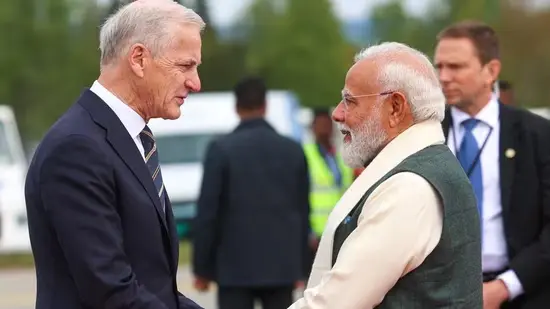
In The Hague and then more spectacularly in Oslo, the Indian delegation adhered to a strict, non-negotiable protocol: statements would be read, hands would be shaken, but no questions would be taken from the floor. When Helle Lyng Svendsen, a correspondent for Norway’s Dagsavisen, broke protocol to shout a question at the departing prime minister—asking why the leader of the world’s largest democracy refused to face the world’s freest press—she was answering a question with a question. The silent exit was the answer.
What followed in the briefing rooms of Oslo was a masterclass in the growing pains of Indian diplomacy. Confronted by the same journalist over India’s plummeting rank on the World Press Freedom Index, Sibi George, a seasoned, Secretary-ranked diplomat, did not deploy the smooth, deflecting jargon of old-school statecraft. Instead, he bristled.
In a response that careened from the civilizational triumphs of ancient India—the invention of zero, the origins of chess—to a sharp denunciation of “ignorant NGOs,” the diplomat made it clear that India considers the Western yardstick of democratic hygiene to be not only irrelevant, but offensive.
To look at this exchange as merely a bad day at the office for India’s Foreign Service is to miss the profound psychological and institutional shift underway in New Delhi. This was not a failure of diplomacy; it was the deliberate manifestation of a new diplomatic doctrine.
Under Modi, India no longer feels the need to audition for the approval of the West. If the price of global stature is submission to the cross-examination of the Fourth Estate, New Delhi has decided it simply will not pay.
Beneath this defensive posture lies a fascinating study in political psychology. Modi’s aversion to the unscripted press conference is well-documented; he has not held a single open one at home since ascending to power in 2014. Critics often attribute this to a fear of tough questioning, a remnant of a disastrous, walk-out television interview early in his career.
But that explanation is too simplistic. It misinterprets a calculated exercise of sovereign will as mere cowardice. In the psychological framework of the current ruling dispensation, the traditional media is not an instrument of public enlightenment, but an elite, adversarial gatekeeper—an outdated relic of an old establishment that seeks to diminish a self-made leader.
By refusing to engage, Modi is not hiding; he is deplatforming the press. His silence is an assertion of absolute control, a statement that the leader of 1.4 billion people answers only to the masses, not to the interlocutors of the editorial page.
This institutional bypass has been made entirely possible by the architecture of social media. For Modi, platforms like X, YouTube, and Instagram are not merely promotional tools; they are the sovereign infrastructure of his political survival.
With an online army of over a hundred million followers, the Prime Minister has achieved what every modern politician dreams of: absolute disintermediation. He can rally a nation, announce major policy shifts, and project an image of infallible strength directly to the smartphones of his voters without a single journalist asking a follow-up question.
On any given day, the digital colosseum reflects this total polarization. Millions of posts flash across the grid, a near-even split between a highly coordinated, fiercely loyal base that elevates him to the status of a civilizational savior, and an equally vociferous opposition that decries him as an authoritarian. But in the arithmetic of direct communication, the content of the criticism matters far less than the volume of the noise.
By keeping the conversation trapped in a permanent online civil war, the government ensures that a unified, critical journalistic narrative can never take root.
Yet, while this strategy works flawlessly within the domestic echo chamber, it produces severe friction when exported. The Oslo incident revealed a widening chasm between how India wishes to be perceived and how its representatives behave when the script breaks down.
When Indian diplomats respond to questions about press freedom by telling foreign journalists that their inquiries stem from a “lack of understanding” or by retreating into centuries-old history, it does little to project the image of a confident, rising superpower. Instead, it signals a thin-skinned vulnerability. It suggests an administration so accustomed to total compliance at home that it panics when faced with the basic democratic hygiene of the outside world.
The long-term danger for India is not a loss of tourist dollars or trade deals; it is the steady erosion of its soft power. For decades, India’s unique selling proposition on the global stage was that it was not China. It was messy, loud, and economically complicated, but it was fundamentally transparent—a country where the rule of law and a free press provided a stable, familiar environment for global partners.
When Indian statecraft begins to mirror the stonewalling tactics and wolf-warrior rhetoric of its authoritarian neighbor to the north, it voluntarily surrenders that democratic premium.
There is a way out of this diplomatic cul-de-sac, but it requires a fundamental reassessment of what strength looks like. True sovereign confidence is not demonstrated by the ability to walk away from a microphone; it is proven by the ability to stand before one.
India’s Foreign Service does not need to be retrained in the art of the defensive crouch; its leaders need to be reminded that a nation of India’s undeniable economic, technological, and geopolitical weight can easily survive a few uncomfortable questions from a European reporter. If the Indian government wishes to be treated as a true global leader, it must accept that scrutiny is the global currency of leadership.
To hide behind civilizational achievements from three millennia ago to avoid answering for the press freedom of today is an admission of weakness, not a declaration of pride. It is time for New Delhi to realize that the art of the press conference is not a trap to be avoided, but an arena to be conquered.
Until the Prime Minister steps up to the lectern without a script, India’s great march onto the world stage will always be shadowed by the sound of its own retreat.