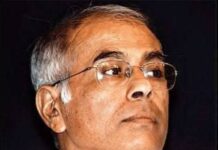
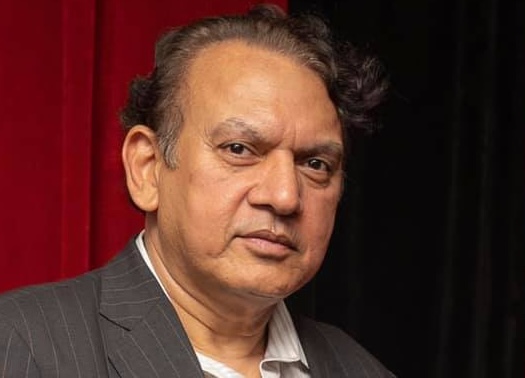
On a gray New England morning, Satish Jha sits by a window overlooking a quiet street in Wellesley, a mug of tea cooling beside him, speaking about India as if it were a manuscript still being revised. “Nations,” he says, “are drafts. Some get edited well. Some never get past the first version.” He says it lightly, but the line lands with the weight of someone who has spent a lifetime watching institutions rise, falter, and reinvent themselves.
Jha has lived many lives — journalist, editor, technologist, policy thinker, poet — but he carries them lightly, as if they were chapters in a book he hasn’t quite finished writing. What binds them is a restless conviction that ideas matter, not in the abstract way universities talk about them, but in the way roads, schools, and constitutions matter. Ideas, for him, are infrastructure.
He grew up in the intellectual arc of North India — Madhubani, Allahabad, Varanasi — places where argument is a civic sport and memory a form of inheritance. “In those cities,” he says, “you learn early that thinking is not a luxury. It’s a survival skill.” Later, at Jawaharlal Nehru University, he absorbed the discipline of theory and the unruliness of politics. “JNU taught me that ideas have consequences,” he says. “And that bad ideas have casualties.”
By his mid‑twenties, he was already an editor in the national press, shaping the public conversation at a time when India was renegotiating its identity. He persuaded Ramnath Goenka to launch Jansatta, a Hindi daily that would become a landmark in Indian journalism. He led Dinamaan, founded by Agyeya, with a team of writers who treated reportage as literature and literature as a form of dissent. “We believed journalism could still change things,” he says. “Some days I still believe that.”
But journalism, for all its urgency, wasn’t enough. “I wanted to understand the machinery behind the headlines,” he says. That curiosity pulled him into technology just as India was beginning to imagine itself as a digital nation. He worked with global technology firms, advised governments, and watched as the country’s relationship with technology shifted from aspiration to dependence.
“Technology is never neutral,” he says. “It reorganizes power long before it improves productivity.” He leans forward, as if to underline the point. “Every new tool redraws the map of who decides, who benefits, and who gets left behind.”
It’s a line that could appear in a policy paper, but Jha delivers it like a poet. And perhaps that is the key to understanding him: he is a strategist who thinks in metaphors, a technologist who speaks in parables, a journalist who still believes in the moral weight of narrative.
His recent work — including The Full Plate, a book that blends education, economics, and institutional design — reflects this synthesis. It is part blueprint, part manifesto, part meditation on what it means for a society to prepare its young for a world that is changing faster than its schools. “Education,” he says, “is the only long-term strategy a nation has. Everything else is tactics.”
He is unsparing about the gaps he sees. “India has brilliance,” he says. “What it needs is scaffolding.” By scaffolding he means institutions — not the bureaucratic kind, but the conceptual ones: systems that create trust, accountability, and imagination. “Nations rise on the strength of their institutions,” he says. “Technology accelerates; institutions stabilize. Without the second, the first becomes noise.”
This is the kind of line that makes policymakers lean in. It is also the kind of line that makes poets smile.
In conversation, Jha moves easily between registers — from the philosophical to the practical, from the historical to the speculative. He can speak about the political economy of education with the precision of an economist, then pivot to the metaphysics of memory with the lyricism of someone who has spent years writing poems in two languages. “Poetry,” he says, “is how I test the tensile strength of an idea. If it breaks in a poem, it won’t survive in policy.”
He is equally at home in the world of philanthropy, where he has helped shape educational initiatives in the United States and India. At a recent Vidyabharati gala in Boston, he spoke not about charity but about responsibility. “Philanthropy,” he said that evening, “is not generosity. It is the recognition that we are all shareholders in the future.”
When asked what keeps him restless, he pauses for the first time. “India,” he says finally. “The sense that it is one good idea away from a different destiny — and that we haven’t yet learned to take ideas seriously enough.”
There is no bitterness in his voice, only a kind of disciplined hope. “Nations don’t fail because they lack resources,” he says. “They fail because they lack the courage to imagine differently.”
As the conversation winds down, the afternoon light shifts across the room. Jha returns to the window, watching the quiet street outside. “The future,” he says, almost to himself, “belongs to societies that learn to think in systems rather than slogans.”
It is a line that could serve as the thesis of his life’s work — a reminder that ideas, when taken seriously, are not abstractions but engines. And that the people who tend to those engines, quietly and persistently, shape more of the world than we often realize.
*Mona Chopra leads the TiE Angels for Women Investors in Boston. She studied at Loreto College in Calcutta and studied for MA in economics at St Xavier’s, Calcutta. She started a small flower shop that is known as Ferns & Petals now and later earned an MBA from Babson College. She is most proud of working with Dean Kamen, the creator of Segway and has worked in leadership roles in major banking and fintech institutions in Boston area.
Author: Mona Chopra