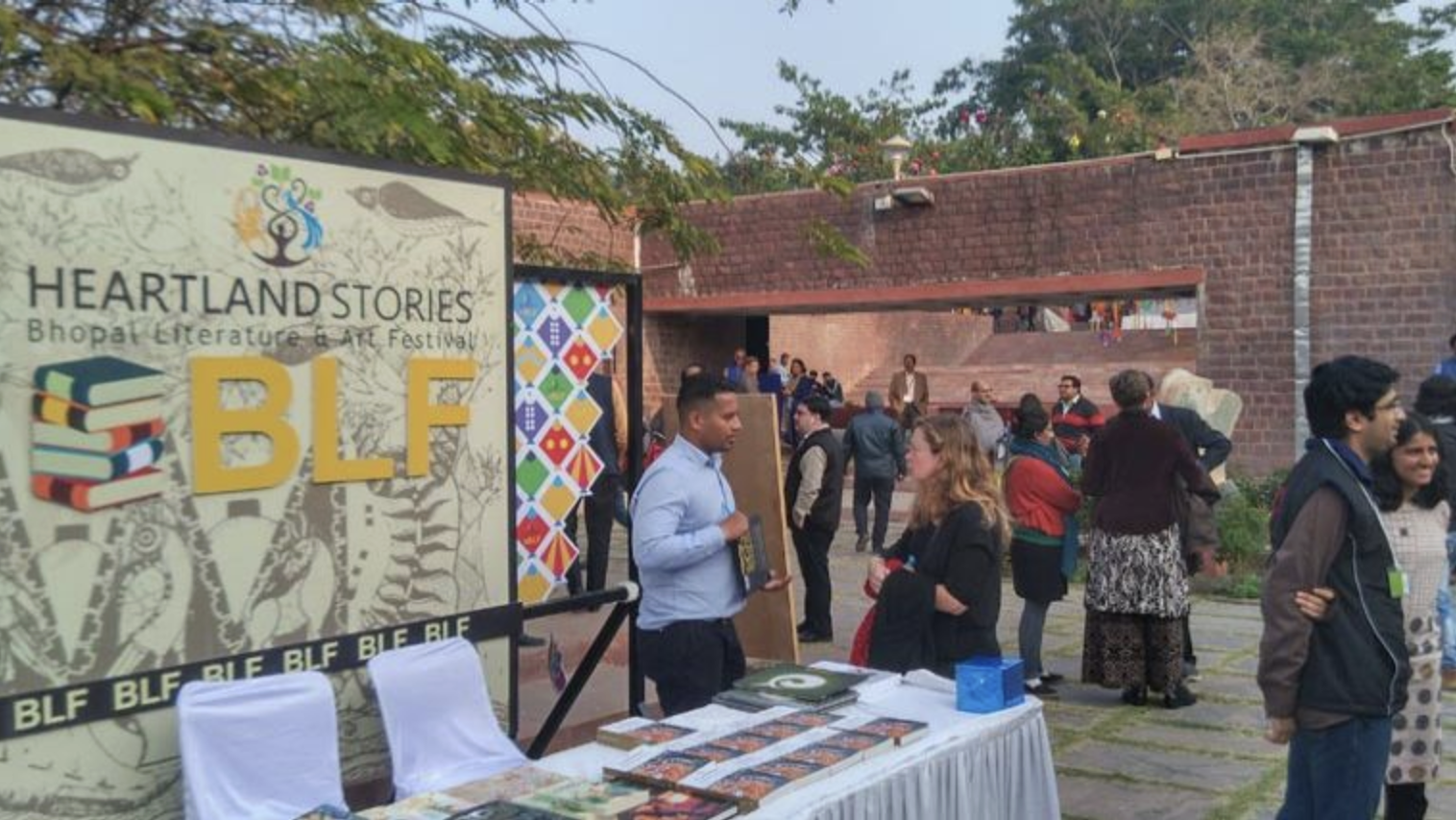
In an age when literary festivals increasingly resemble cultural carnivals—thronged crowds, celebrity glare, and social media’s ceaseless hum—it is easy to mistake visibility for vitality. Scale dazzles; substance must often fend for itself. Ideas become performances, dialogue becomes content, and listening becomes incidental.
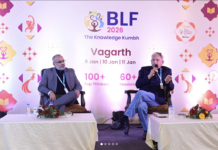
Against this rising decibel level, something rare has been unfolding in central India. The Bhopal Literature and Art Festival (BLF), now in its eighth edition (January 2026), offers a counterpoint so deliberate and so quietly assured that it feels almost subversive. It is not smaller by accident. It is restrained by design.
BLF does not announce itself with spectacle. It invites attention—and then rewards it.
Started in 2019 by retired IAS officer Raghav Chandra, BLF was conceived as an act of cultural responsibility rather than ambition. Bhopal, for all its lakes, history, tribal heritage, and classical traditions, had remained curiously under-exposed to sustained engagement with global ideas shaping a rapidly transforming world. The absence was not of culture, but of conversation.
BLF emerged to fill that vacuum—not by imitating larger festivals, but by building as if setting aside their assumptions.
India’s flagship literary festivals have undeniably expanded the country’s cultural imagination. Jaipur Literature Festival, with its imperial scale and global luminaries, has made reading aspirational and public. Kerala Literature Festival blends literature with politics, performance, and activism, echoing the state’s intellectual temperament. Both have enriched the ecosystem.
But success brings its own peculiarities. Growth begins to reward spectacle; density gives way to dispersion. One listens less because there is always something else beginning elsewhere.
BLF moves in the opposite direction. With no ticketing, minimal publicity, and no performative glamour, it draws a steady, self-selecting audience—around 25,000–30,000 across four days—not driven by hype but by curiosity. Sessions are full not because of celebrity pull, but because people stay. They listen. They ask questions that reveal preparation, not posturing.
The atmosphere is not frenetic. It is attentive, creating an architecture that listens
The festival unfolds across three carefully interlinked strands.
At its core is a tightly curated knowledge and literature programme: roughly sixty hourly conversations that refuse to rush either speakers or audiences. Topics range widely—geopolitics and defence, climate and ecology, strategy and management, heritage and civilizational memory, cybersecurity, space, AI and human cognition, startups and state capacity. Books are entry points, not endpoints. What matters is relevance, not release cycles.
What is striking is the quality of listening. School students sit through demanding sessions with a seriousness rarely credited to them. College volunteers—drawn from IIT Bhopal, NID, NIFT, SPA, National Law School, IIFM, and others—manage stages, introduce speakers, moderate transitions, and handle logistics with a professionalism that would flatter far larger festivals. Their confidence is quiet, their preparation visible. They are not helpers; they are custodians of the experience.
The second strand—the tribal art camp—is BLF’s most distinctive intervention. Indigenous art here is neither decorative nor nostalgic. Around eighty young tribal artists from ten states work alongside senior practitioners in a setting focused on skill transmission, institutional linkages, and economic sustainability. The proximity to Bhopal’s Tribal Museum—globally admired for its curatorial integrity—is not incidental. The festival treats tribal knowledge as contemporary intelligence: living, evolving, and economically meaningful.
The third strand belongs unapologetically to youth. Open competitions in poetry, storytelling, painting, and a widely popular quiz on history, culture, environment, and world affairs are woven into the festival’s main fabric. These are not side-events. They are signals—to students in a tier-2 city—that their voices belong in serious cultural spaces.
What emerges is not a hierarchy of speakers and listeners, but a continuum of participation, building on heartland stories, globally tuned
BLF’s unifying principle—Heartland Stories—demands that ideas remain tethered to place. Every abstraction must carry a human geography. Every global question must touch local soil. In Madhya Pradesh, quite literally the heart of India, this grounding matters. It disciplines the conversation. It resists drift.
Raghav Chandra’s own intellectual journey shapes this sensibility. A career civil servant who once lost a manuscript on colonial-era policing to the nomadism of transfers, he later returned to writing with Scent of a Game—a forensic, morally alert account of tiger poaching amid institutional failure—and Kali’s Daughter, a novel probing caste, identity, and estrangement through a Dalit woman’s life in the foreign service.
His curation is self-driven yet globally alert, informed by years of engagement with Delhi’s intellectual circuits and his teaching of public policy and governance at IIM Kolkata. The result is international benchmarking without commercial mimicry that may ignore the intelligence of the audience
What ultimately distinguishes BLF is not its programming, but its public.
Speakers routinely remark on the quality of questions—probing, unscripted, often challenging. Sessions unfold without the restlessness familiar at larger festivals. During an extended storytelling session on Adi Shankara, audiences remained riveted—defying the assumption that contemporary attention spans cannot sustain narrative depth.
The praise BLF attracts is unsolicited and consistent. Authors, journalists, and scholars describe it as among the finest festivals they have experienced in India—immaculately organized, intellectually serious, and atmospherically warm. KJ Alphons, former Union Cabinet Minister, who inaugurated the festival in 2019, returned this year and called it the best literature festival he had attended—remarkable not only for execution, but for how far it had evolved beyond its original conception.
Such assessments matter because they are not promotional. They are observational and underline why this model matters
India’s literary future cannot rest solely on megafestivals. It requires a constellation of rooted, high-integrity centres—especially in tier-2 and tier-3 cities—where curiosity is abundant but platforms are scarce. BLF demonstrates what becomes possible when seriousness is trusted and known audiences are respected.
Its influence is already visible. District officials replicate elements locally. Smaller towns experiment with mini-festivals. Media narratives increasingly speak of Bhopal’s quiet cultural reawakening.
The path forward lies not in scaling up, but in deepening further: formalizing the tribal art camp through advanced institutional partnerships; taking youth programmes on the road; refining interdisciplinary curation; and undertaking modest global outreach—particularly for NRI and PIO visitors seeking meaningful cultural engagement rather than spectacle. Improvements in basic infrastructure and sustained public–private support would amplify impact without diluting character.
In an AI-accelerated world—where speed erodes reflection and replication threatens originality—spaces that reward composers acquire disproportionate value. BLF reminds us that listening is not passive. It is an ethical act.
The Bhopal Literature and Art Festival does not aspire to be the loudest voice in the room. It achieves something rarer and more durable: it restores the conditions under which ideas can be heard, absorbed, and argued with care. In that quiet attentiveness lies not only a festival’s success, but a template for cultural life that endures.
(Satish Jha co‑founded Jansatta for the Indian Express Group and served as Editor of Dinamaan at The Times of India. Later, he helped bring the One Laptop per Child (OLPC) project to India and now works with schools to introduce simple, affordable technologies—what he calls a “cellphone of education”—to support learning in more than 50 K-12 institutions)