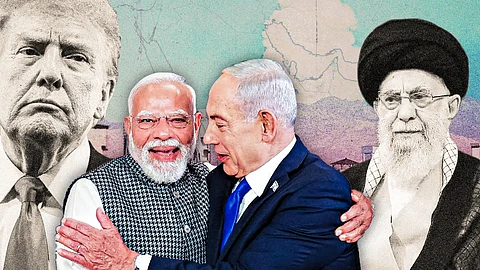
The targeted killing of Iran’s supreme leader, Ali Khamenei, in strikes widely attributed to Israel and the United States, marks a watershed in contemporary geopolitics.
For the first time in the modern era, a sitting head of state has reportedly been eliminated outside a formally declared war between sovereign equals. Even in a century that has normalized drone warfare and covert operations, this is escalation of a different order. If sovereignty can be pierced at the very top, without multilateral sanction and without war’s formal threshold, then the guardrails that separated rivalry from systemic breakdown grow dangerously thin.
India’s response — careful, calibrated, and notably devoid of direct condemnation — reflects the logic of modern statecraft. New Delhi has deepened defense ties with Israel. It relies on American capital and technology. It imports energy from a volatile region where millions of its citizens live and work. Prudence, officials would argue, is not cowardice but necessity. Yet history suggests that India’s greatest strategic asset has never been caution alone. It has been moral clarity.
From independence onward, India’s influence has rested less on coercive power than on credibility. Jawaharlal Nehru understood this during the Cold War. Non-alignment was not passivity; it was an assertion that sovereignty mattered even when great powers disagreed. When Britain, France and Israel invaded Egypt in 1956, India’s condemnation of the Suez intervention enhanced its stature far beyond its material strength.
In 1971, Indira Gandhi confronted a humanitarian catastrophe as millions fled violence in what was then East Pakistan. Her government intervened militarily, but framed its actions not as opportunism, but as defense of human dignity and regional stability. The creation of Bangladesh was not merely a strategic gain; it was presented as a moral necessity.
Decades later, after India conducted nuclear tests in 1998, Atal Bihari Vajpayee coupled assertion with restraint, declaring a voluntary moratorium and initiating peace outreach toward Pakistan. Manmohan Singh, while negotiating a landmark civil nuclear agreement with Washington, consistently framed India’s rise within a rules-based global order.
These leaders differed profoundly in ideology. What united them was an understanding that India’s civilizational vocabulary, satya (truth), ahimsa (non-violence), strategic autonomy, was not ornamental rhetoric. It was leverage. The present moment tests whether that leverage still exists.
The Indian government’s defenders argue that condemning the assassination of a hostile regime’s leader risks alienating strategic partners and yielding no practical gain. Why jeopardize relations with Israel or the United States when neither will reverse course? Why appear sympathetic to Tehran’s clerical establishment? Those are serious questions. But they misstate the issue.
Condemning the violation of sovereignty is not the same as endorsing a regime. Extending condolences to a nation’s people is not ideological alignment. India has historically maintained relations across divides precisely because it insisted on principles larger than blocs. Silence, by contrast, carries its own cost.
Nearly nine million Indians, about tge suze of Israel, reside in West Asia. India’s ability to evacuate its citizens during crises, from Kuwait in 1990 to Yemen in 2015, has depended on its reputation as a country that speaks with independent authority. If New Delhi is seen as selectively mute when powerful partners breach norms, that reputation erodes. And with it, diplomatic maneuverability.
There is also a larger strategic horizon. India seeks leadership of the Global South in an increasingly multipolar order. Leadership requires more than growth rates and arms purchases; it requires trust. Smaller nations watch how middle powers respond when the rules are bent by the strong. If India refrains from defending sovereignty at the highest level, its advocacy of a “rules-based order” risks sounding contingent.
None of this demands rupture with Israel or the United States. Partnerships endure frank disagreement. In fact, durable partnerships require it. A statement affirming that extrajudicial assassinations of sitting leaders undermine international stability would not sever alliances; it would reinforce India’s claim to independent judgment.
Realism without principle becomes alignment. Principle without realism becomes sermon. India’s foreign policy tradition has worked when it refused both extremes.
In the 21st century, assassination is becoming normalized as an instrument of statecraft. If that threshold collapses entirely, no state — large or small — can assume immunity. The precedent established today will be invoked tomorrow by others, perhaps against weaker governments, perhaps without even the justification of counterterrorism or imminent threat.
India’s founders believed that power and restraint were not opposites. They were interdependent. Moral clarity did not weaken the republic; it amplified its voice. The question now is not whether India can afford to speak. It is whether it can afford not to.
A brief, carefully worded affirmation of sovereignty, a call for de-escalation, an appeal for multilateral engagement — these would not be acts of naiveté. They would be assertions of identity.
In moments of geopolitical turbulence, nations reveal what they believe about themselves. India has long argued that it represents a civilizational alternative to zero-sum politics, a country capable of engaging Washington, Jerusalem and Tehran without surrendering judgment. That claim is being tested.
Strategic autonomy is not measured by the weapons one buys or the markets one courts. It is measured by the willingness to articulate principles even when silence feels safer. If sovereignty is negotiable, then no rising power is secure. If it is not, then India should say so — clearly, calmly and without rancor.
History rarely announces when a norm has broken. It simply moves on as if the new threshold were inevitable. The killing of a sitting head of state outside declared war may prove to be such