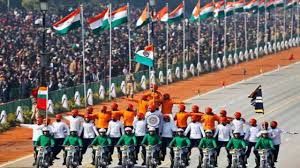
The 76th Republic Day dawns not just as a parade of pride, but as a quiet mirror held up to our soul as a nation. On this January 26, 2026, as the tricolor rises over Kartavya Path, let us pause—not just to cheer what we have built, but to confront what we have left unfinished.
Seventy-six years ago, we gave ourselves a Constitution that promised justice, liberty, equality, and fraternity—not as lofty poetry, but as binding law for every Indian, from the palace to the pavement.
We inherited towering leaders who dreamed big: visionaries who stitched a fractured land into one republic, strong hands that steered us through wars and crises, thoughtful minds that debated every clause of our sacred document, and yes, even the strongman who promised swift destiny.
We have celebrated them all. But the true measure of a republic is not in the stature of its leaders, but in the dignity it delivers to its last citizen—the one who waits in line for five kilograms of grain each month, the one whose child is born into hunger, the one whose talent rusts in a jail cell awaiting trial.
We promised ourselves a sovereign, socialist, secular, democratic republic. Yet, look around. We feed nearly 800 million citizens through the world’s largest food security net, doling out five kilograms of subsidized grain per person per month under the National Food Security Act. It keeps bodies alive, but barely. That ration card is our confession: we still cannot ensure that every child goes to bed with a full stomach nourished by dignity, not charity.
While a hundred million Indians enjoy smartphones, streaming dreams, and gig-economy hustles in uniquely Indian ways—a little less data here, a bit more buffering there—the rest remain tethered to the same old promise of survival.
And above this fragile balance looms another truth: wealth itself has become dangerously concentrated. The richest 1% of Indians now own over 40% of the nation’s wealth, while the bottom half together hold barely 6.5%. Such imbalance is not just an economic statistic—it is a democratic warning.
When prosperity is monopolized by a glittering few, constitutional commitments to equality and fraternity risk becoming hollow words. A republic cannot thrive if its wealth is the privilege of a handful, while its millions survive on rations and subsidies.
We boasted of a demographic dividend, a youthful bulge that would power us to greatness. Instead, we squandered it. Youth unemployment lingers stubbornly high—often touching 40% or more in the 20–24 age group in recent months—while millions of our brightest pack their ambitions and fly abroad.
Brain drain is not a statistic; it is a national hemorrhage. We mined the earth for coal and minerals, chasing yesterday’s wealth, when the real gold lay in mining minds. We forgot to groom our demography, to feed it knowledge, skills, and opportunity. The dividend became a liability not because fate willed it, but because we failed to invest in it.
From the moment of conception, nine out of ten of our future citizens are denied what they deserve. Mothers lack adequate nutrition, clean water, and prenatal care. Toddlers grow up stunted—not just in body, but in potential—missing the food for thought that turns curiosity into innovation.
By the time they reach their teens, too many are funneled into manual, menial labor, their aspirations clipped before they can bloom. Malnutrition stalks us still: wasting rates hover around 17–18% among children under five, anemia grips two-thirds of our young, and district after district hides pockets of undernutrition that threaten entire generations.
We proclaim equality on paper, yet reality mocks us. Our prisons overflow with undertrials—nearly three-quarters of all inmates, many languishing for years, even decades, without trial. Hundreds of thousands, disproportionately from the margins of caste, class, and faith, wait in cells the size of forgotten nations. Justice delayed is justice denied, and in India, it is denied on an industrial scale.
Our victories are often claimed in ancient glory—BC triumphs of philosophy and science—while contemporary battles for dignity go half-fought. We export our best and brightest to bloom elsewhere, universities abroad harvesting what we sowed but never nurtured. Everything we achieve seems confined to a glittering few—a tiny elite whose success blinds us to the vast forgotten majority. The view is large enough to obscure the rest.
Yet despair is not our destiny. We stand at the threshold of our centenary, with barely a couple of dozen years to redeem the promise. The clock ticks, but the hour is not yet lost.
Imagine an India where dignity is not a slogan but a birthright—no matter how distant one stands on the privilege scale. Where every child receives not just grain, but nourishment for body and mind from cradle to classroom. Where talent is scouted not by passports but by potential, groomed here to contribute at the frontiers of aspiration. Where laws apply equally, not as instruments of punishment but as gentle reminders of duties and obligations toward one another. Where no violence stains our streets or our hearts, and fraternity is lived, not merely recited.
This is no utopia; it is the Ram Rajya our scriptures envisioned—not a kingdom of one ruler, but a republic of shared righteousness, peace, and happiness for all. A nation that does not need to proclaim who it is, because every citizen feels it in their bones.
We can still do it. We must redirect our gaze from the glittering summits to the silent valleys. Invest in the mother before the child, the school before the smartphone, the skill before the subsidy. Turn our demographic bulge into a dividend of dreams realized. Release the undertrial, not as mercy, but as justice overdue. Feed the mind as fiercely as we feed the body. And above all, ensure that wealth is not the monopoly of a few, but the shared inheritance of all.
Seventy-six years have tested us. The next twenty-four will define us.
Let this Republic Day be the day we resolve: no more half-measures, no more forgotten millions. Let us build the India we promised ourselves—not for the headlines of tomorrow, but for the quiet smile on the face of the last Indian who finally believes the Constitution was written for them too.
Because in the end, a republic’s true wealth is not in its GDP or its missiles, but in the number of its citizens who wake up feeling free, equal, and hopeful.
Jai Hind