
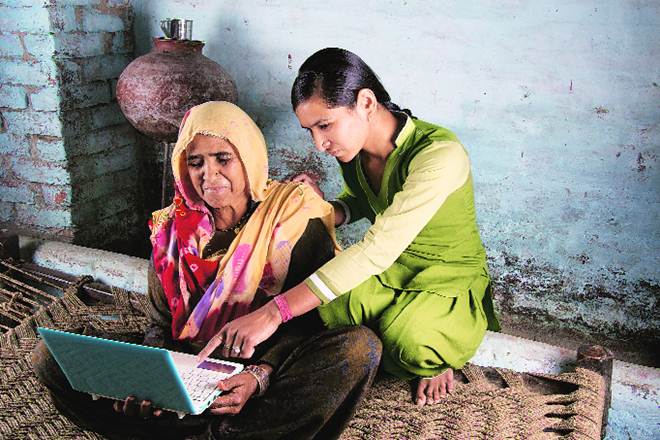
In Satnavari, a modest village in Maharashtra’s Nagpur district, a quiet miracle is unfolding. What was once a weary Anganwadi centre—its walls faded, its promise forgotten—has become the unlikely epicenter of a digital dawn. Children who once trudged reluctantly into dull classrooms now rush in with anticipation, their eyes lit by the glow of tablets that carry stories, games, and lessons into their hands. Parents, long disillusioned by rote learning and the crushing fees of private convent schools, are enrolling their children here instead.
This reversal is not merely unusual; it is historic. For decades, the tide flowed one way—from public to private. Now, in Satnavari, the current has turned. Families are choosing public institutions because they have begun to outshine the private. When such a reversal occurs, you know a revolution has begun.
India’s Anganwadis were designed as the first rung of the educational ladder, serving over 80 million children under six. Yet the promise faltered. Budgets stretched thin, workers underpaid and overburdened, tools primitive. Too often, these centres became holding pens rather than nurseries of learning.
Neuroscience underscores the tragedy: ninety percent of a child’s brain develops before the age of five. To squander those years is to squander a nation’s future. In rural India, where stunting affects forty percent of under‑fives and cognitive delays plague low‑resource areas, the cost is catastrophic—not just for children, but for the country’s GDP.
We are squandering 90% of a child’s potential before they even reach school.
In an age driven by artificial intelligence, analogue villages cannot compete. The National Education Policy 2020 rightly emphasizes foundational literacy, but execution lags. Technology offers the leapfrog.
Globally, ed‑tech has democratized access. In Karnataka’s Mangaluru, smart TVs spark interactive learning. In Bangladesh, Sesame Street’s localized version advances girls’ education. The lesson is clear: when pedagogy meets pixels, miracles happen.
Edufront, supported by Ashraya, embodies this leap. Launched in late 2025, it delivers Marathi‑aligned content—videos, gamified quizzes, tests, and Q&A—on offline‑ready Android devices. Workers track progress against standards, turning guesswork into data. In Satnavari, children now engage with words, numbers, and problem‑solving through play.
Edufront has turned curiosity into currency—the only wealth that multiplies when shared.
The impact is immediate. “Before Edufront, we had only basic charts,” one Anganwadi worker told me. “Now, children engage with words, numbers, problem‑solving through games.”
But the real story lies in migration patterns. For decades, the flow was one‑way: from public to private schools. Satnavari has reversed it. Families are pulling children out of convent schools and enrolling them in the Anganwadi. Why? Because learning here is fun, not forced.
This echoes my experiences with One Laptop Per Child (OLPC), where devices ignited curiosity even in remote areas. Edufront is not merely upgrading Anganwadis; it is proving that public institutions, armed with the right tools, can outshine private ones.
Edufront’s model mirrors a timeless success: Sesame Street. Since 1969, the show captivated underserved children in America with Muppets teaching ABCs and empathy. Studies confirmed gains in vocabulary and math that persisted into adulthood. Localized in 150 countries, Sesame Street reaches 156 million children, addressing local issues from literacy to gender equality.
Its secret? Research‑driven, entertaining content that engages. Edufront channels this for India’s villages: play‑based, adaptive modules in local languages, building competencies where rote fails. In Satnavari, children tackle shapes via avatars, stimulating brains during peak plasticity—much like Elmo teaching counting.
Yet Edufront extends Sesame’s model. Offline access overcomes infrastructure gaps. Teacher dashboards empower overburdened staff. Parental modules, in the works, will reinforce home learning. Early data shows doubled engagement and improved skills. Scaled to 1.4 million centres, Edufront could standardize Early Childhood Care and Education (ECCE), aligning with NEP.
Of course, hurdles remain. Training workers demands sustained effort. Not all centres have power or devices. Parents must be convinced that Anganwadis are not mere feeders but educators. Policy must integrate technology systematically, with funding to match ambition.
As I argued in my Fair Observer critique of NEP, cosmetic changes won’t suffice. We need bold investment. Per‑child ECCE spending must rise from ₹8,297 to levels that enable quality. Co‑locating Anganwadis with schools, as planned for 11 lakh centres, could aid tech rollout. Public‑private partnerships, modeled on Sesame Street, offer pathways.
India cannot afford half‑measures in early learning. Every rupee under‑invested today costs us ten tomorrow.
Through Ashraya, we remain committed. Focused on digital ecosystems for the underserved, we have backed Edufront’s expansion—one village at a time. Satnavari’s success inspires: laughter over tablets, children prepared for life.
Policymakers must take note. Untapped potential costs GDP dearly; early investments yield $7–16 per dollar, according to global studies. Until reforms come, we will press on.
जिन Satnavari’s reversal lies India’s redemption: a nation where every child, rural or urban, unlocks their full promise.
India’s villages are not waiting for permission. They are scripting their own digital dawn. Edufront’s quiet revolution in Satnavari is proof that with vision, technology, and commitment, even the most modest Anganwadi can become a beacon of hope.
The unpardonable truth is this: if we fail to scale such models, we condemn millions of children to squandered potential. If we succeed, we unleash a generation ready to thrive in the AI era.
The choice is ours.
Early learning is not charity—it is the most strategic investment a nation can make.